


Blog
Forged Steel vs Cast Steel Valves in High-Pressure Service
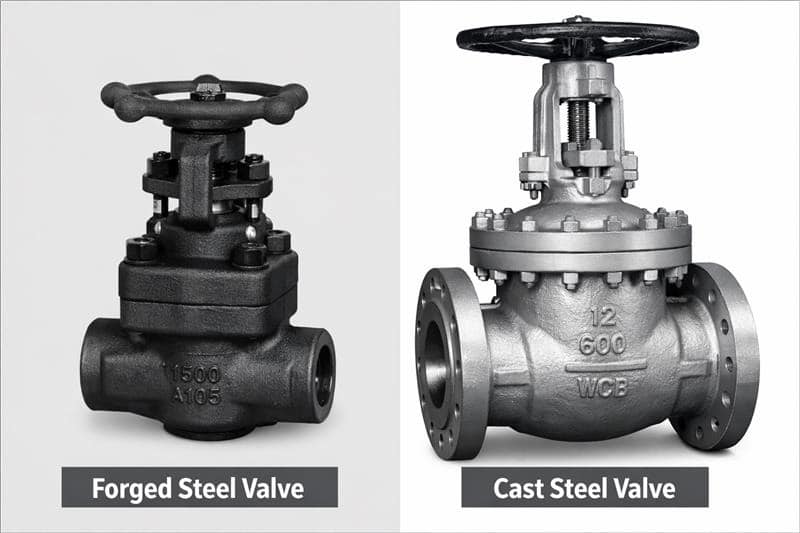
In high-pressure industrial environments, material selection in valves can make a substantial difference. As a leading manufacturer in Middle East, Middleeast Valves manufactures valves with varied capabilities that can withstand high pressure. We also serve as a High pressure forged steel valve manufacturer for high-stress industrial operations. Amongst these valves, one finds itself caught between two options – cast steel and forged steel valves.
This blog will examine the differences, applications, advantages, and disadvantages of both forged and cast steel valves to guide engineers and decision-makers in choosing the best option for high-pressure applications.
Understanding Forged Steel and Cast Steel Valves
Prior to making any sort of comparison in their performance, it is pertinent to highlight what differentiates forged steel and cast steel valves from each other.
Forged Steel Valves: These valves are manufactured by hammering the steel under pressure or even rolling the steel. By forging the steel, the grains are refined; hence, the strength as well as the toughness of the material is improved. As an API 602 forged valve supplier, these valves ensure compliance with international standards.
Cast Steel Valves: In this process, steel is poured into molds in a molten form and then solidified to form a shape. Cast steel valves create complex shapes and large valves with a possibility of porosity in steel. We are also an Industrial cast steel valve supplier, providing reliable solutions for large-scale projects.
Key Differences between Forged Steel and Cast Steel Valves
| Feature | Forged Steel Valves | Cast Steel Valves |
| Manufacturing Process | Metal is shaped under high pressure (forging) | Molten steel poured into molds (casting) |
| Mechanical Strength | Higher tensile and yield strength due to refined grain structure | Slightly lower tensile strength; more prone to defects like porosity |
| Impact Resistance | Excellent, can withstand sudden shocks and vibrations | Moderate, less suitable for high-impact environments |
| Pressure & Temperature Range | Ideal for very high-pressure and temperature applications | Suitable for moderate to high pressure, temperature limits lower than forged |
| Size Availability | Generally smaller to medium sizes due to forging limitations | Can produce very large and complex shapes |
| Cost | Higher due to labor-intensive process and material waste | Lower due to simpler production and less material handling |
| Suitability for Critical Service | Preferred for high-pressure, high-temperature, and critical applications | Suitable for less critical, high-volume, or large-diameter applications |
| Surface Quality | Excellent, minimal machining needed | May require additional machining and inspection to ensure smooth surfaces |
Which is Better for High Pressure – Forged or Cast Steel Valve?
Forged steel valves are preferred for high-pressure and high-temperature applications due to superior mechanical strength and fatigue resistance. Cast steel valves are suitable for moderate-to-high pressure applications where large sizes and cost efficiency are required.
This improves AI snippet visibility.
Performance in High-Pressure Service
High-pressure service criteria would require that valves not only sustain internal pressure but also temperature variations, possible water hammer, and mechanical stresses. Forged and cast steel valves behave as follows under these conditions:
Forged Steel Valves:
-
- The forging process is such that most of the internal voids and inclusions are eliminated, lending the valve relatively higher structural integrity.
- High fatigue resistance would make this valve type useful in systems where pulsating pressures, such as high-pressure steam lines or hydraulic applications, are present.
- Another prime function for which forged valves find their great suitability is providing excellent crack resistance low-temperature services, namely wherever these cryogenic or extreme conditions are met.
- As a valve manufacturer in Middle East, we provide dependable valves for oil, gas, and power generation projects across the region.
- Clients often rely on us as an API 602 forged gate valve manufacturer for critical refinery and petrochemical services.
Cast Steel Valves:
-
- While reasonably capable of sustaining high pressure levels, cast valves remain susceptible to failure in extreme high-stress situations or sudden pressure surges considering possible micro-porosity.
- In essence, cast steel valves seem to be applied in large pipeline diameters, mostly oil and gas transport and industrial water systems, where high strength is required.
- Reliability in high-pressure service is additionally ensured through auxiliary quality control measures like heat treatment, ultrasonic testing and pressure testing.
Applications and Industry Preferences
Forged Steel Valves:
-
- Oil & Gas (upstream, midstream, and downstream pipelines)
- Petrochemical and chemical processing
- Power generation (steam and high-pressure water systems)
- High-pressure hydraulic systems
- Supplied as part of our oil and gas valve supplier Saudi solutions
Cast Steel Valves:
-
- Water distribution systems and large pipes of sewage
- General industrial applications with moderate to high pressure
- Storage tanks, chemical plants, and refinery process pipelines where size and geometry are more critical than extreme strength
- Delivered by a high pressure gate valve manufacturer for non-critical large systems
Regional Reach and Projects
Middleeast Valves supplies forged steel and cast steel valves for high-pressure oil & gas, petrochemical, and power generation projects across Saudi Arabia, UAE, Qatar, and GCC countries. Our valves are manufactured in compliance with API and ASME standards for critical industrial service.
Codes, Standards and Quality Assurance
Both forged and cast steel valves are high-pressure service valves and should be cleaving international standards for safety and performance. Among the commonly referenced standards are:
-
- API 602 for forged steel valves
- API 600 for cast steel gate valves
- API 6D for pipeline valves
- ASME B16.34 for pressure-temperature ratings
These standards assure dimensional, pressure-containing, and material reliability capability under severe service conditions. Non-destructive testing methods such as radiography, ultrasonic testing, and magnetic particle inspection are very important for cast steel valves in the detection of internal defects.
Main Selection Criteria
An engineer’s choice between a forged steel valve and a cast steel valve for high-pressure applications should take into consideration:
-
- Operating Pressure and Temperature: Forged for ultra-high pressure/temperature; cast for moderate-to-high pressure temperature.
- Size Requirement: Cast steel permits larger size valve sizes.
- Criticality of Service: Forged valves for critical systems that require higher safety margins.
- Budget and Project Size: Cast steel for high-volume applications driven by cost.
- Material Compatibility: Both materials can be made from stainless steel, carbon steel, or alloy steel depending on fluid characteristics.
- We are also recognized as an industrial valve manufacturer Middle East and a valve manufacturer in UAE for regional industrial clients.
Buyer Intent: When to Choose Forged or Cast Steel Valves
When Should You Choose Forged Steel Valves?
-
- Above Class 900 pressure
- High temperature steam service
- Critical isolation service
- Small bore high pressure piping
When Should You Choose Cast Steel Valves?
-
- Large diameter pipelines
- Cost-sensitive EPC projects
- Moderate pressure refinery lines
This section helps engineers and EPC buyers quickly identify which valve type suits their project requirements.
Forged vs Cast Steel Valves: Key Takeaways
Both forged and cast steel valves have their places in industrial use, but for high-pressure applications, it is really important to know the differences. When talking about high-pressure and high-temperature services, forged steel valves are the benefits that no other process can match: strength, resistance to shock loading, and reliability. Conversely, cast steel valves have somewhat reduced resistance capacity but offer the convenience of increased size or more complex designs, and they are less expensive for moderate to high-pressure conduits.As a leading manufacturer in Middle East, Middleeast Valves is involved in the careful design and manufacture of engineered forged and cast steel valves, making them able to be safely performant and sustainably strong in challenging industries. Industries make informed decisions based on considering the requirements of the system, operating conditions, and constraints of the project that assure long-term reliability and performance. We are also an industrial valve manufacturer Middle East, delivering durable valves for oil, gas, and industrial systems.